Author: Allie Herry

  • How to Spot a Fake Gaming Website: Checks Before You Sign Up or Deposit

    How to Spot a Fake Gaming Website: Checks Before You Sign Up or Deposit

    Every popular game and platform eventually attracts imitators: copycat sites with near-identical logos, promising bigger bonuses, built to harvest deposits and personal details. Learning how to spot a fake gaming website is now a basic skill for anyone who plays online. The good news is that fake sites are usually careless in predictable places. A calm five-minute check of the licence, the domain, the payment options and the site’s own text will expose most of them before any money moves.
    Gaming collage

    Start With the Licence — and Verify It Properly

    Legitimate gaming sites operate under a licence from a recognised regulator, and they display the licence number in the footer. Displaying a number, however, proves nothing: fake sites copy footer text wholesale. The real check is to go to the regulator’s own website — typed into your browser yourself, never via a link on the site you are checking — and search its public register for the company name and licence number. If the register shows a different company, an expired licence, or nothing at all, you have your answer. Also check that the licence covers the activity being offered: a site licensed for one product quietly offering several others is a classic half-legitimate setup that leaves players unprotected when something goes wrong.

    Read the Domain Name Like a Detective

    Cloned sites live on lookalike addresses. The tricks are small and deliberate: an extra letter, a swapped character that looks identical on screen, a different ending such as .net instead of .com, or the real brand name embedded inside a longer address like brandname-bonus.example.com. Train yourself to read the exact domain in the address bar before entering any password, and reach the site through your own bookmark or a search you performed yourself rather than through links in messages, comments or social posts — those links are the main delivery route for clones. A very new domain is another warning: legitimate platforms have usually operated for years, while phishing clones are often registered days before they appear.

    Follow the Money: Payment Red Flags

    How a site asks to be paid reveals a great deal. Established platforms offer traceable methods — cards, bank transfers, recognised e-wallets — processed by named payment companies. Fake sites push hard in the opposite direction: deposits only by voucher codes, gift cards, cryptocurrency to a personal wallet, or transfers to an individual’s bank account, all methods that cannot be reversed once sent. Pressure is a tell of its own. Countdown timers on deposit bonuses, support agents urging you to “deposit now before the offer closes,” and withdrawal rules that keep changing — deposit more to unlock your balance is the most infamous — are techniques no regulated operator is allowed to use. If withdrawing sounds more complicated than depositing, walk away before, not after.

    Inspect the Site Itself

    Fake sites are assembled quickly, and it shows in the details. Click through pages a real business would maintain: the About page, terms and conditions, privacy policy and responsible-gaming information. On clones these are often missing, copied with another site’s name left in the text, riddled with spelling errors, or written in a language that does not match the rest of the site. Check the contact options: a real operator provides more than a web form — a company address, a registration number, working email and support that answers questions about licensing without evasion. Test support with exactly that question before depositing anything. Vague, delayed or irritated answers to “who regulates you?” are all the answer you need.

    What Other Players Report

    Before signing up anywhere new, spend two minutes searching the site’s name together with words like “scam,” “withdrawal problem” or “not paying.” One complaint proves little, but patterns are informative: repeated reports of blocked withdrawals, accounts closed after wins, or bonuses with impossible conditions describe how a site behaves when it matters most. Independent review sites and player forums have usually encountered a bad operator before you. Also search the exact bonus offer being advertised; clones frequently recycle the same unrealistic welcome package across dozens of disposable domains, and the offer itself becomes the fingerprint.

    Apps, Downloads and Social Media Clones

    The website is only one door. Fake operators also distribute lookalike mobile apps through direct download links, messaging groups and sponsored posts, bypassing the checks that official app stores apply. Treat any app offered as an APK file or a download from a social post as unverified until you find the same app listed on the platform’s official store page, published by the company named in the licence. Social media is the other hunting ground: cloned brand pages run fake giveaway posts, reply to players from near-identical handles, and send “support” messages asking for passwords or one-time codes — something real support never requests. Check the handle letter by letter, look at when the page was created and how consistent its posting history is, and never log in through a link a page sends you. The pattern to remember is that fakes always push you to hurry and to arrive through their link; real platforms are content for you to find them yourself, slowly, through the front door.

    A Five-Minute Routine Worth Keeping

    Knowing how to spot a fake gaming website compresses into a short habit: verify the licence on the regulator’s own register, read the domain character by character, insist on traceable payment methods, read the terms and About pages for copy-paste sloppiness, and search for player complaints before depositing. Five minutes of scepticism protects both your money and the personal documents sign-up processes ask for. Save the routine for every new platform, however convincing it looks — and once you are playing somewhere trustworthy, the fun returns to the games themselves, like the hand ladders explained in our guide on how card game rankings work.
  • How Card Game Rankings Work: Hand Strength From Poker to Teen Patti

    How Card Game Rankings Work: Hand Strength From Poker to Teen Patti

    Every card game has a moment where two players turn over their hands and one of them wins — and deciding who wins is never a matter of opinion. Understanding how card game rankings work means understanding the ladder of hand strength each game uses, why that ladder is ordered the way it is, and how the same cards can be powerful in one game and worthless in another. Whether you play poker with friends, Teen Patti at a festival, or rummy with family, the rankings are the shared language that makes the game possible.

    Playing cards

    The Core Idea: Rarer Hands Rank Higher

    Almost every ranking system in card games follows one principle: the harder a hand is to make by chance, the higher it ranks. A standard deck has 52 cards, and the number of ways to draw any given combination can be counted exactly. Three of a kind, for example, is far more common than a straight, which is far more common than a flush. Rankings simply arrange hands from most likely to least likely and pay the rarest hands the most. This is why rankings feel fair even to new players: the hand that wins biggest is the hand you will see least often. When you understand that rankings are probability written as a list, you stop memorising and start reasoning — if a hand sounds harder to build, it almost certainly outranks the easier one.

    Poker Rankings: The Reference Ladder

    Five-card poker uses the most widely known ladder, and many other games borrow from it. From lowest to highest: a high card (nothing matched, the highest card plays), one pair, two pair, three of a kind, a straight (five cards in sequence, not of the same suit), a flush (five cards of the same suit, not in sequence), a full house (three of a kind plus a pair), four of a kind, a straight flush (in sequence and the same suit), and at the very top the royal flush — ace, king, queen, jack and ten of one suit. Ties are broken by the rank of the cards involved: a pair of kings beats a pair of queens, and when the main hands match exactly, the side cards, called kickers, decide. Poker also has a famous wrinkle: the ace plays both high and low, so A-2-3-4-5 counts as the lowest possible straight.

    Teen Patti Rankings: Three Cards, Different Order

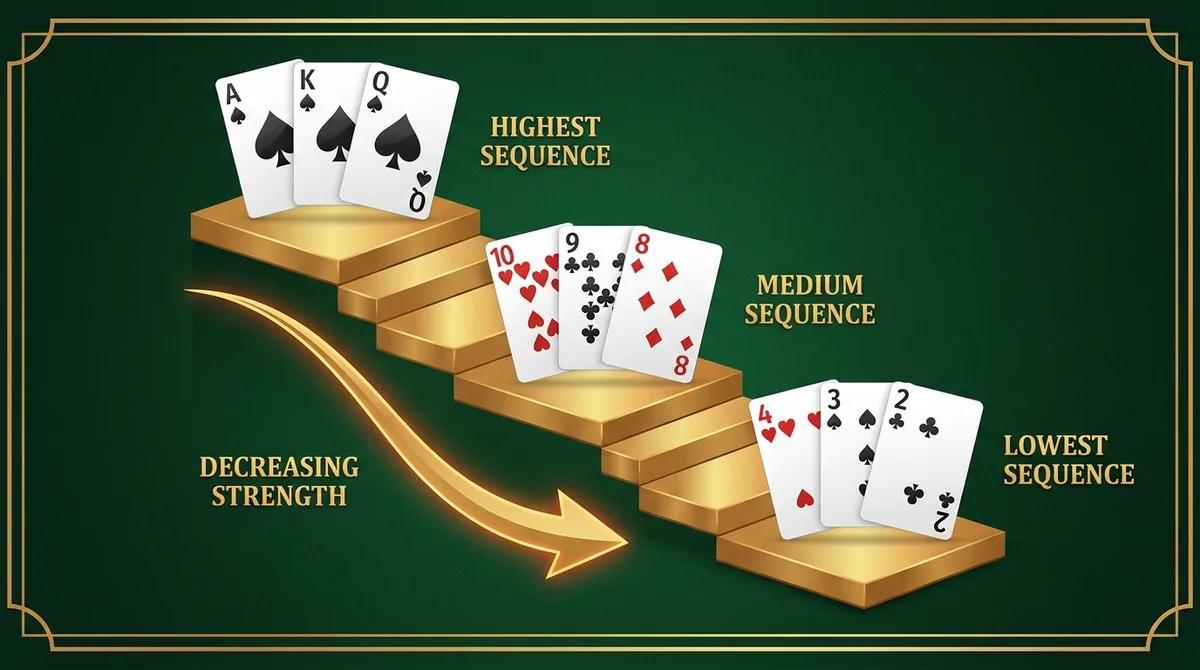
    Teen Patti, played across India and hugely popular at festivals and family gatherings, uses three cards instead of five, and that changes the maths completely. From lowest to highest, the Teen Patti ladder runs: high card, pair, colour (three cards of the same suit — the equivalent of a flush), sequence (three cards in a row — the equivalent of a straight), pure sequence (in a row and the same suit), and at the top a trail, also called a trio or three of a kind, such as three aces. The surprising part for poker players is that three of a kind sits ABOVE the sequences here. With only three cards, a trail is genuinely rarer than a pure sequence, so the probability principle pushes it to the top. Suits themselves carry no rank in standard Teen Patti, and as in poker the ace can complete both the highest sequence (Q-K-A) and the lowest (A-2-3).

    Rummy: Rankings Become Sets and Sequences

    Rummy uses the same building blocks but arranges them differently. Instead of one hand beating another on a ladder, each player builds melds: sets of three or four cards of the same rank, and sequences of three or more cards in a row in the same suit. A pure sequence — built without a joker — is mandatory in Indian rummy before anything else counts. The ranking idea is still present, though: the pure sequence is the foundation because it is the hardest requirement to fake, printed jokers and wild cards substitute for missing cards but cannot replace that one pure run. Understanding rummy means thinking less about a single showdown and more about which combinations you are closest to completing at any moment.

    How to Read a Hand Quickly

    Experienced players evaluate a hand in seconds using a fixed order of checks. First, look for matched ranks: is there a pair, three or a trail? Second, check suits: are all the cards the same colour or suit? Third, check sequence potential: are the values consecutive or one card away? Running those three checks in order tells you both what you hold and what you are drawing toward. In betting games this reading speed matters because your decisions — play, raise, or fold — should track how your hand compares with the full ladder, not just whether it “looks good.” A pair of aces is a monster in Teen Patti and an ordinary hand in five-card poker; the cards did not change, the ladder did.

    Rankings Are Only Half the Story

    Knowing how card game rankings work gives you the rules of strength, but every card game also has a layer of judgement on top: position, betting patterns, and the discipline to fold a decent hand when the situation says someone else holds better. The rankings never change, which is exactly why they are worth learning properly — they are the one fixed point in a game of shifting information. And because so much card play has moved online, the fixed points matter off the table too: our companion guide on how to spot a fake gaming website covers the checks that protect your account and money before you play anywhere new.

  • Family Movie Night: How to Pick a Film Everyone Will Enjoy

    Family Movie Night: How to Pick a Film Everyone Will Enjoy

    Few traditions are as simple, or as quietly wonderful, as gathering everyone in one room, dimming the lights, and watching a film together. A Family Movie Night costs almost nothing, needs no travel, and gives parents, children, and grandparents a shared story to laugh about and quote for weeks. Yet anyone who has spent forty minutes scrolling through options while the popcorn goes cold knows the weak point of the evening: choosing the film.

    The good news is that picking well is a skill, not luck. With a little preparation and a few ground rules, the choosing takes five minutes and the evening itself becomes the easy, happy ritual it was always meant to be.

    Start With the Audience, Not the Catalogue

    The most common mistake is searching for a universally perfect film. It does not exist. What exists is a film that suits the people actually in the room tonight. Think about the youngest viewer’s limits first: the right choice is one the smallest person present can follow and enjoy without being frightened or bored. Older children and adults are far more flexible, and most well-made family films are written with layers that reward every age watching.

    Consider the mood of the day, too. After a tiring week, a gentle comedy or a colourful animated adventure lands better than a long, serious drama. On a rainy holiday afternoon, a longer adventure story might be exactly right. Matching the film to the evening — rather than to an abstract idea of quality — is the real secret of hosts who always seem to choose well.

    Take Turns Choosing

    The fairest system ever invented for movie night is also the simplest: rotate the choice. Each week, a different family member picks the film, with everyone else agreeing to watch it in good spirit. Children take enormous pride in their pick, adults get gently pushed outside their usual tastes, and the endless negotiation disappears because the decision has already been made by the rota.

    A small amount of structure keeps it working. The picker chooses from a pre-agreed pool of suitable films — a family watchlist you build together over time. Anyone can add to the watchlist when they hear about something good, which turns recommendations from friends, teachers, and colleagues into future movie nights. When it is your turn, you simply pick the title you most want from the list and save the rest for later weeks.

    Use Games to Break a Deadlock

    Some nights, nobody can decide and nobody wants to take the blame for a bad choice. That is the perfect moment to let chance decide. Write three suitable titles on slips of paper and draw one from a bowl. Spin a wheel, roll dice against a numbered list, or let the youngest person point at a poster with their eyes closed. A film chosen by luck carries no one’s reputation with it, so everyone can relax and simply enjoy it.

    It helps to build the shortlist from trustworthy places. Just as game lovers rely on guides when they want to explore the best free online games for endless entertainment, film lovers do better with curated “best family films” lists and ratings from other parents than with endless aimless browsing. Ten minutes of list-browsing during the week beats forty minutes of scrolling on the night itself.

    Check the Details Before You Press Play

    A two-minute check saves most movie night disasters. Confirm the running time fits the evening — a three-hour epic is a poor choice before a school day. Skim a parent-oriented review for anything you would rather your children skip; these reviews describe specific scenes far more usefully than an age rating alone. And check where the film is available before you announce it, so the evening does not begin with a disappointed search across four different services.

    Sound and picture deserve a moment as well. Set up the seating, cushions, and blankets before the film starts, keep the remote within reach, and agree on the volume while the opening scene plays rather than arguing about it midway through a quiet conversation scene.

    Snacks, Breaks and Small Rituals

    Half the memory of movie night is everything around the film. Popcorn is traditional for a reason, but the ritual matters more than the menu: the same special drink, a shared bowl of something, or a homemade ticket handed to each viewer can turn an ordinary evening into an event children talk about all week.

    For longer films, a planned intermission helps everyone — a pause halfway for drinks, the bathroom, and a quick stretch keeps younger viewers fresh for the ending. And when the credits roll, give the film five minutes of talk. What was the funniest moment? Who was the bravest character? These small conversations are where a film becomes a family memory rather than just something that played on a screen.

    Movie Night Is Part of a Bigger Entertainment Picture

    Families who enjoy films together often enjoy other shared entertainment too, and the same relaxed approach works across all of it. Game nights, puzzle afternoons, and film evenings all thrive on the same ingredients: taking turns, keeping things fair, and choosing with the whole group in mind. If your family is building a broader menu of free entertainment at home, our complete guide to finding the best free games online is a handy companion for the non-movie nights.

    The point is not the size of the screen or the newness of the film. It is the habit of spending unhurried time together, on purpose, with the phones put away.

    The Bottom Line

    A successful Family Movie Night is built before anyone sits down: a watchlist ready to pick from, a fair rota for choosing, a quick check of length and content, and a few small rituals that make the evening feel special. Do that light preparation once, and every week after becomes simple — press play, pass the popcorn, and enjoy being together. It is the cheapest tradition your family will ever keep, and very likely the one everyone remembers longest.

  • Best Mobile Games You Can Play Free on Any Phone

    Best Mobile Games You Can Play Free on Any Phone

    The most powerful games machine most people own is already in their pocket. Modern phones handle graphics, sound, and online play that would have seemed impossible not long ago, and the app stores are filled with thousands of free titles competing for your attention. The challenge is no longer finding a game — it is finding the right one. The Best Mobile Games share a few qualities: they are easy to start, satisfying in short sessions, fair about what they ask from you, and kind to your battery and storage space.

    This guide looks at the main styles of free mobile gaming, what makes a title worth keeping on your home screen, and how to enjoy phone gaming without it taking over your day or your device.

    Every Style, Right in Your Pocket

    Puzzle games remain the heart of mobile gaming, and for good reason. Match-three puzzlers, word games, number puzzles, and clever logic challenges fit perfectly into small moments — a bus ride, a coffee queue, a quiet pause between tasks. They ask little of your phone and a lot of your brain, which is a satisfying trade.

    Action fans have endless runners, simple shooters, and racing games built around quick reflexes and short rounds. Strategy players can manage farms, build cities, or command little armies in games designed to be checked on a few times a day rather than played for hours. Card games, board game classics, and trivia titles round out the selection, and many let you play against friends or friendly strangers online. Whatever your taste, there is a free version of it waiting in the store.

    What Separates a Good Mobile Game From a Forgettable One

    Install counts alone can mislead. A better test is how a game treats you in the first ten minutes. Good games teach you by letting you play, not by burying you in instruction screens. They run smoothly on ordinary phones, not just the newest flagship models, and they do not demand half your storage for a simple puzzle.

    Fairness matters too. Many free games are supported by advertising or optional purchases, and that is fine — as long as the free experience is complete and enjoyable on its own. A game that constantly blocks your progress unless you pay is not really free; it is a toll booth. The titles worth keeping let you play fully and happily without spending anything, and simply offer extras for those who want them. Our roundup where you can explore the best free online games for endless entertainment applies the same thinking: free should mean free.

    Playing Across Devices and Platforms

    One pleasant surprise of modern gaming is how easily play moves between devices. Many popular titles exist in phone, tablet, browser, and even console versions, and plenty of players switch between them depending on where they are. Games that began life on games platforms such as Dm Play, for example, introduced many people to whole families of casual titles they later sought out on their phones — our guide to games on Dm Play explains the main types you will meet there.

    If you play on more than one device, look for games that save your progress to an account so your levels and achievements travel with you. It is a small feature that makes a big difference to how relaxed your gaming feels.

    Keeping Your Phone Happy

    Mobile games are guests on a device you also need for calls, messages, photos, and work, so a little housekeeping helps. Before installing a large game, check its size and whether your phone has room to spare — a nearly full phone slows down everything, games included. Games with heavy 3D graphics drain batteries quickly, so they are better suited to home play near a charger, while puzzles and card games sip power and suit travel days.

    It is also wise to review what a game asks permission to access. A simple puzzle has no need for your contacts or location. Permissions that do not match what the game actually does are a good reason to choose a different title. Finally, keep games updated through the official app store: updates fix bugs, improve performance, and close security gaps.

    Healthy Habits for Phone Gaming

    Mobile games are designed to be picked up often, and their little rewards and daily challenges can quietly turn five minutes into fifty. Enjoy them with a bit of structure: play during genuine downtime rather than opening a game out of habit, turn off non-essential notifications so the game does not summon you, and let some moments in the day stay game-free.

    For parents, the same settings that protect adults are even more valuable for children. Check age ratings before installing, switch on the store’s parental controls, and make sure in-game purchases require your approval. A game that is perfectly suitable can still surprise a family budget if a child discovers the shop button.

    Finding Your Next Favourite

    The easiest way to build a small collection you love is to try widely and keep ruthlessly. Download two or three games in different styles, give each an honest ten minutes, and delete anything that does not earn its place. Your home screen should hold games you are genuinely glad to see, not a museum of maybes.

    Recommendations from friends are often better than charts, because a friend knows your taste. And when you want fresh ideas beyond the usual top-ten lists, browsing curated collections of free titles — sorted by style rather than hype — is the fastest route to a hidden gem.

    The Bottom Line

    The Best Mobile Games are not the loudest or the most heavily advertised; they are the ones that respect your time, your battery, and your wallet while giving you a genuinely good few minutes whenever you ask. With a little care in choosing and a few healthy habits in playing, your phone becomes what it quietly already is: a pocketful of entertainment, ready whenever you are, wherever the day happens to take you.

  • Free Browser Games: How to Play Instantly Without Any Downloads

    Free Browser Games: How to Play Instantly Without Any Downloads

    There was a time when playing a game on a computer meant buying a disc, waiting through a long installation, and hoping your machine was powerful enough to run it. Today, some of the most enjoyable gaming happens in the most ordinary place on your computer: the web browser you already use every day. Free Browser Games have quietly become one of the easiest ways to enjoy a quick puzzle, a fast race, or a relaxing strategy challenge, because they ask for nothing more than a browser tab and a few spare minutes.

    Whether you are taking a short break at work, relaxing at home on a laptop, or passing time on a tablet, browser gaming fits into moments that full game downloads never could. This guide explains how these games work, which types are worth your time, and how to play them smoothly and safely.

    What Are Browser Games, Exactly?

    A browser game is any game that runs directly inside a web browser such as Chrome, Firefox, Edge, or Safari. Instead of installing software on your device, the game loads from a website and runs using standard web technology. Modern browsers are surprisingly capable: they can handle colourful 2D graphics, smooth animations, sound, and even impressive 3D worlds that would have required a dedicated console a generation ago.

    Because nothing is installed, browser games are also easy to leave behind. Close the tab and the game is gone — no files cluttering your hard drive, no uninstallers, and no worries about a download slowing your machine down weeks later. Many games save your progress automatically through the site or a free account, so you can return to the same puzzle or level whenever you like.

    The Main Types You Will Find

    The variety on offer is much wider than most people expect. Puzzle games are the classic starting point: match-three games, word games, Sudoku, and logic challenges that are easy to learn and satisfying to finish. Arcade-style games deliver quick reactions and high scores, from endless runners to simple shooters and racing games that load in seconds.

    Strategy and simulation fans are well served too, with city builders, farming games, and tower defence titles that reward planning over reflexes. Card and board game collections recreate chess, solitaire, mahjong, and classic board games against computer opponents or real players. And for social players, multiplayer browser games let you compete or cooperate with people around the world in everything from trivia quizzes to real-time battles — all without a single download.

    Why Instant Play Matters

    The biggest advantage of Free Browser Games is the lack of friction. There is no store to visit, no storage space to check, and no update to wait for before you can start. You click, the game loads, and you are playing within seconds. That makes browser games perfect for short sessions: a ten-minute break, a wait for an appointment, or a quiet half hour in the evening.

    Instant play also makes it easy to explore. If a game does not grab you in the first few minutes, you can simply try another. With thousands of titles available, experimenting costs nothing but a click. If you are not sure where to begin, our complete guide to finding the best free games online walks through how to sort the genuinely good titles from the forgettable ones.

    How to Choose Games Worth Your Time

    A few simple habits will help you find quality quickly. First, look at how a game presents itself: clear instructions, a clean screen without excessive pop-ups, and smooth loading are all signs of a well-made title. Second, check whether the game respects your time. Good free games let you enjoy the full experience without constant interruptions, even if they offer optional extras.

    It also helps to match the game to your mood and available time. A deep strategy game deserves a relaxed evening, while a word puzzle suits a five-minute pause. Keeping a small personal list of favourites — two or three in each style — means you always have the right game ready. For ideas across every style, you can explore the best free online games for endless entertainment and bookmark the ones that catch your eye.

    Tips for Smooth, Trouble-Free Play

    Most browser games need very little from your device, but a few small steps keep everything running well. Keep your browser updated, since newer versions handle games faster and more securely. If a game feels sluggish, close other heavy tabs — streaming video and dozens of open pages compete for the same memory. A stable internet connection matters most for multiplayer games, where a dropped connection can end a match.

    Sound is worth checking too: many games start quietly, but some announce themselves loudly, which is not ideal in a shared space. Most have a mute button in a corner of the screen. Finally, if a game asks you to create an account to save progress, use a unique password you do not use elsewhere, the same sensible habit that applies everywhere online.

    Playing Safely and Sensibly

    Stick to well-known game sites, and be cautious of any page that asks you to download a special player or installer before a supposedly browser-based game will run — genuine browser games do not need one. Avoid entering payment details for a free game, and treat any offer that sounds too good to be true with healthy suspicion.

    It is also worth remembering that free games are designed to be enjoyable in short bursts, and that is exactly how they are best enjoyed. Set the game aside when your break ends, and let it be a small pleasure in the day rather than a distraction from it. Played that way, browser gaming is one of the simplest, cheapest, and most cheerful forms of entertainment the internet offers.

    The Bottom Line

    Free Browser Games prove that great entertainment does not require expensive hardware, long downloads, or any cost at all. With nothing more than a browser, you can puzzle, race, build, and compete in seconds, wherever you happen to be. Start with a style you already enjoy, keep a short list of favourites, and let the humble browser tab become your quickest route to a well-earned break.